Indian Name: (Coriander)
Dhania
Botanical Name :
Coriandrum Sativum
Family Name : Apiaceae
Coriander is
popularly grown for
its culinary and
medicinal
properties.
Coriander is the
native herb of North
Africa and Southwest
Asia, advisable for
usage while it is
fresh, as its leaves
lose the flavor and
aroma on drying.
Coriander is never
cooked as it also
diminishes its
flavor. Coriander
Powder is popularly
used for flavoring
the dish.
Sunrise Spices
Coriander Powder are
best in quality has
an aromatic odor.
Packaged in
different corrugated
and poly-pouches,
Sunrise Spices
powdered coriander
is free from
moisture and other
dirt particles.
Description
Coriander is an
important spice crop
having a prime
position in
flavouring food.
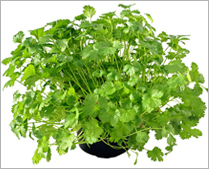
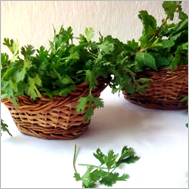
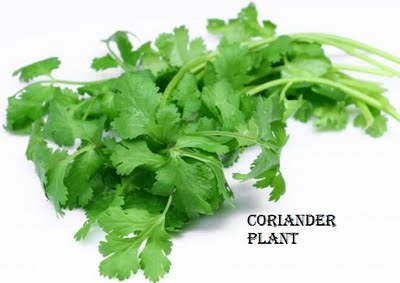
The plant is a thin
stemmed, small,
bushy herb, 25 to 50
cm in height with
many branches and
umbels. Leaves are
alternate, compound.
The whole plant has
a pleasant aroma.
Inflorescence is a
compound umbel
comprises 5 smaller
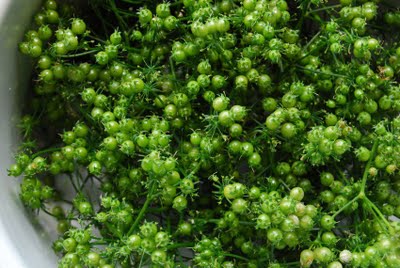
umbels. Fruit is
globular, 3 to 4 mm
diameter, when
pressed break into
two locules each
having one seed.
Fruit has delicate
fragrance; seeds are
pale white to light
brown in colour.
There are two
distinct
morphological types,
one erect and tall
with a comparatively
stronger main shoot
and the other bushy
with a relatively
weaker main shoot
and longer spreading
branches.
Propagation and
Planting
The propagation of
coriander is through
seeds. Seeds can be
sown directly in the
garden or in a
container or pot.
Plant the seeds 1/2"
to 1" deep, 2-3 feet
apart in rows and
rows should be 15"
apart. Coriander
traditionally
germinates very
slowly and can take
as long as 21days to
emerge. Ensure
regular watering and
that the soil is
warm enough for
speedy germination.
The plant prefers
well drained loamy
soils rich in
organic matter with
a pH of 5.5 to 6.5.
Soil should not be
too rich with
organic matter as
too much nitrogen
lessens the flavour.
The plant requires
partial shade but
fairly high
temperature and
sufficient water.
The plant can be
kept in full sun but
must be shaded
during the heat of
day to protect
against sunscald.
Too much heat can
damage the fruit.
They need a long
season to ripen, so
choose an early
variety.
Coriander leaves can
be picked when the
plant is immature
i.e only a few
inches tall. Fresh
tender leaves have
better flavour. But
seeds ripen only
after a long season
say about 2 1/2
months before they
are ready to be
picked. Harvest
seeds when fruits
turn brown and
before they shatter.
Mature or ripe
fruits have a
distinct spicy
aroma. Leave the
seed heads in a dry
airy place for
2-3days. Shake off
the seeds and store
for later use.
Coriander Indian
Names
Coriander in
international
languages
Bengali
Dhana, Dhania
Marathi
Dhana
Gujarati
Kothmiri,
Libdhaba
Sanskrit
Dhanyaka
Hindi
Dhania or Dhanya
Tamil
Kothamalli
Kannada
Kothambri,
Kothamiri bija
Punjabi
Dhania
Telugu
Dhaniyalu
Spanish
Culantro
French
Corriandre
Arabic
Kuzhbare
Chinese
Hu-sui
Swedish
Koriander
Portuguese
Coentro
Russian
Koriandr
Japanese
Koendoro
Dutch
Koriander
Trade in Coriander
Global
Scenario
Coriander seeds are
also used in whole
or powdered form for
food seasoning and
flavoring. Canada,
Morocco, India,
Pakistan, Bulgaria
and Romania are the
major coriander
producing countries.
Russia is the prime
producer of
coriander oil used
in liquor,
pharmaceutical and
chemical industry.
Indian Scenario
India is a major
coriander powder
producing country.
Production is done
in a number of
states on a
commercial basis.
Gujarat, Rajasthan,
Andhra Pradesh,
Tamilnadu and Madhya
Pradesh are major
Indian production
areas. A significant
percentage of the
total coriander
produced is used for
domestic consumed
and the rest is
exported.
Uses of Coriander
A
simple treatment
with coriander
powder, recommended
for psycho-emotional
disorders, is the
following: 0.004lb
of powder taken four
times a day, for a
49 days period with
a pause of 10 days.
In the case of liver
cancer and colon
cancer it is
recommended to take
four spoons of fresh
coriander powder
each day, for at
least three months.
The same treatment
can be used for
mammal cancer. The
treatment must be
sustained by a low
fat diet. Any
hydrogenated fats
are completely
forbidden.
Salad It can be used
to treat allergies.
Coriander leaves
contain natural
antihistamines,
vitamin C and
bioflavonoids that
decrease the
allergic reactions
such as hay fever.
The cures must be 12
days long and they
are especially
recommended if the
exposal to allergic
factors is intense.
The high content of
bioflavonoids from
the leaves helps
also in the cases of
hemorrhoids, varices
and other veins
disorders.
Used externally, the
juice made up from
the fresh herb is
good for allergies
and cutaneous
eruptions. Dry
coriander fruits can
be used to obtain
oil that will help
against fatigue and
lethargies. It can
be used also for
stomachal massage
and abdominal
massage in cases of
bad digestion,
colics, distend,
diarrhea. Because of
its heating and
analgesic effect,
coriander is very
useful for calming
the rheumatic pains
and states of flu or
cold. It can be
applied locally.
History
The use of coriander
can be traced back
to 5,000 BC, making
it one of the
world's oldest
spices. It is native
to the Mediterranean
and Middle Eastern
regions and has been
known in Asian
countries for
thousands of years.
Coriander was
cultivated in
ancient Egypt and
given mention in the
Old Testament. It
was used as a spice
in both Greek and
Roman cultures, the
latter using it to
preserve meats and
flavor breads. The
early physicians,
including
Hippocrates, used
coriander for its
medicinal
properties,
including as an
aromatic stimulant.
The Russian
Federation, India,
Morocco and Holland
are among the
countries that
commercially produce
coriander seeds.
Coriander leaves
(cilantro) are
featured in the
culinary traditions
of Latin American,
Indian and Chinese
cuisine.
Health & Nutrition
Benefits of Eating
Coriander
* Coriander leaves
act as stimulants
and tonics for the
stomach,
strengthening its
functions as well as
promoting digestion.
* Coriander seeds
have been associated
with offering a
feeling of coolness
and also reducing
fever.
* It has been seen
that coriander helps
in the removal of
phlegm and also aids
secretion and
discharge of urine.
* Containing an
antibacterial
compound, cilantro
has been found to
provide a natural
means of fighting
Salmonella, a cause
of food-borne
sickness.
* Coriander has
anti-inflammatory
properties that
might alleviate
symptoms of
arthritis.
* Researches have
pointed out that
coriander helps
stimulate the
secretion of insulin
and also lowers
blood sugar.
* Coriander keeps
health problem at
bay, by helping
lower bad
cholesterol and
raise good
cholesterol.
* Consumption of
coriander seeds has
been known to lessen
excessive menstrual
flow.
* Coriander juice,
when mixed with a
pinch of turmeric
powder, serves as an
effective remedy
against pimples,
blackheads and dry
skin.
* Cilantro is good
for treating nausea
and intestinal gas
and is also a good
source of dietary
fiber.
* Coriander has been
fount to provide
effective protection
against urinary
tract infections.
Nutritional Value of
Coriander
Given below is the
amount of nutrients
in 100 gm of
coriander
Coriander
seed is generally
used coarsely ground
or more finely
powdered, depending
on the texture
desired. It is best
bought whole as,
being brittle, it is
easy to mill or
pound in a mortar.
Ground coriander is
apt to lose its
flavour and aroma
quickly and should
be stored in an
opaque airtight
container. Whole
seeds keep
indefinitely. Their
flavour may be
enhanced by a light
roasting before use.
As coriander is
mild, it is a spice
to be used by the
handful, rather than
the pinch. The
leaves can be
chopped or minced
before use. They
lose flavour when
dried, but may be
frozen either
blanched or chopped
and frozen into ice
cubes.
Quality Assurance
As we believe in
providing quality
products that are
close to nature, we
conduct various
stringent quality
tests under the
supervision of the
experts. These tests
are performed with
due care from the
very initial stage
of procurement of
the products to the
final stage of
delivery to the end
users.
Packaging
We also provide
reliable packaging
of the cardamom seed
oil and other
cardamom products.
During the packaging
procedure, we keep
the hygienic level
high and also ensure
that there is no
human touch.
Moreover, the
packaging has also
helped in the easy
and safe delivery of
the products.
We are dealing with
various esteemed
clients located in
India as well as in
the markets of New
Zealand and Dubai.
We also promise to
serve a superlative
range of cardamom
and cardamom
products which
includes green
cardamom powder to
our new customers as
we serve to our
existing satisfied
clientele. The
frequent and
concrete feedbacks
from our customers
have also helped in
the advancement of
the managerial
activities and
serving the products
as per the demand
prevailing in the
market. Last but not
the least; we are
also looking forward
to provide more
beneficial deals in
the forthcoming
years.





 Hara miri miri (Coriander
powder)
Hara miri miri (Coriander
powder)


 ©
2008, www.tajagroproducts.com All rights reserved.
©
2008, www.tajagroproducts.com All rights reserved.